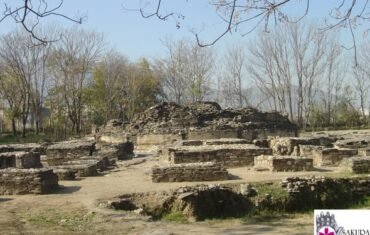
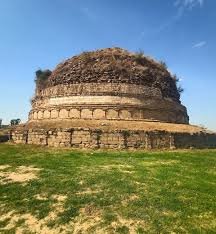
The Dharmarajika Stupa, UNESCO World Heritage Site, located in Taxila, was built during the Mauryan era and underwent renovations during the Kushan era. It’s an ancient Buddhist monument built in the 3rd century BC by Emperor Ashoka. It’s a significant archaeological site, showcasing the region’s rich cultural heritage and Buddhist history.
The stupa’s design follows traditional Buddhist architectural principles, symbolizing the path to enlightenment. Its core is a solid hemisphere of earth and stone, encased in a shell of burnt bricks.
The stupa was built to house sacred relics of the Buddha. The site includes several monasteries built during different periods, featuring quadrangles and cells for monks. These monasteries demonstrate the evolution of Buddhist monastic architecture. The stupa features intricate carvings, stucco decorations, and floral motifs, showcasing the artistic skills of ancient craftsmen. These decorations convey religious teachings and stories.
The site was devastated by the White Huns in the 5th century CE, leading to its abandonment. Sir John Marshall excavated the site in 1913, revealing its complex history and significance.
Ashoka’s conversion to Buddhism is a pivotal moment in history, transforming him from a ruthless king to a benevolent leader. According to historical records, Ashoka’s journey to Buddhism was likely a gradual process, influenced by various factors.
The Kalinga War: Ashoka’s conquest of Kalinga (present-day Odisha) in 261 BC was a turning point. The war resulted in massive casualties, with estimates suggesting over 100,000 deaths. This event deeply affected Ashoka, leading him to reevaluate his priorities.
Ashoka’s encounter with Buddhist teachings and monks, particularly Nigrodha, a young Buddhist monk, played a significant role in his conversion. The monk’s sermon on earnestness resonated with Ashoka, marking the beginning of his devotion to Buddhism.
Ashoka adopted the principle of ahimsa (non-violence), reducing animal sacrifices and eventually banning hunting and meat consumption in his kingdom. He funded the construction of stupas, viharas, and other religious structures, facilitating the spread of Buddhism. Ashoka sent missionaries, including his son Mahinda and daughter Sanghamitta, to propagate Buddhism in Sri Lanka and other regions.
Please feel free to email us or Sakura Travel – Pakistan regarding Gandhara Buddhist Tours for Pakistan.
Sakura Travel – Pakistan
sakuratr2004@gmail.com
WhatsApp: 0332 8501039