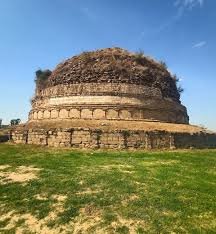
Nestled in the quiet village of Tope Mankiala near Rawalpindi, Pakistan, the Mankiala Stupa stands as a silent witness to the region’s once-flourishing Buddhist civilization. Though now largely neglected, this ancient structure carries immense historical, cultural, and spiritual significance. Built during the Gandhara period, the stupa is a testament to the rich religious diversity that once defined the subcontinent.
The Mankiala Stupa is believed to have been constructed during the reign of Kanishka the Great (128–151 CE), a prominent Kushan emperor and patron of Buddhism. According to Buddhist tradition, the stupa commemorates a Jataka tale, a story from one of the Buddha’s past lives. In this particular tale, the Bodhisattva, then Prince Sattva, sacrifices his body to feed a starving tigress and her cubs. This act of selflessness became a symbol of compassion and the Buddhist ideal of paramita (perfection) in generosity.
Some traditions also suggest that Mankiala is one of the 84 stupas built by Emperor Ashoka in the 3rd century BCE to enshrine the relics of the Buddha. While there is debate over its exact origins, the monument undeniably reflects the deep roots of Buddhism in the region now known as Pakistan.
Architecturally, the stupa follows the typical Gandharan style, with a circular base and a dome-shaped mound. It originally reached a height of about 17 meters, with a base diameter of 21 meters. Constructed primarily from stone and brick, the structure was designed to enshrine sacred relics and serve as a place for meditation and pilgrimage.
Over centuries, the stupa has suffered damage due to natural erosion, looting, and neglect. Despite this, much of the structure still stands, giving modern visitors a glimpse into the craftsmanship and spiritual significance of ancient Buddhist architecture.
The stupa was rediscovered in 1808 by Mountstuart Elphinstone, a British diplomat. Later, in 1830, French archaeologist Jean-Baptiste Ventura excavated the site and uncovered a relic casket containing coins and small objects, believed to be associated with the Buddha. These relics were sent to James Prinsep in India and eventually found their way to the British Museum, where they remain today.
In 2024, a joint archaeological team from Pakistan and South Korea initiated a new excavation project. This recent effort uncovered staircases and chambers beneath the stupa, hinting at a more complex structure than previously known. The project also aims to train Pakistani students in modern archaeological techniques, helping preserve their heritage.
The Mankiala Stupa is more than a historical monument—it is a symbol of the spiritual and cultural harmony that once existed in South Asia. It highlights the presence of Buddhism in ancient Punjab, long before the religion’s decline in the region. The legend of Prince Sattva continues to inspire notions of compassion, sacrifice, and moral duty in both religious and secular thought.
Moreover, the stupa connects modern Pakistan to the Gandhara civilization, which produced some of the earliest depictions of the Buddha in human form and played a key role in the spread of Buddhism across Asia.
The Mankiala Stupa stands as a powerful reminder of South Asia’s deep and diverse spiritual heritage. As one of the few surviving Buddhist monuments in Punjab, it embodies the values of compassion, sacrifice, and peaceful coexistence. With renewed archaeological interest and responsible heritage management, Mankiala could regain its rightful place on the cultural and historical map of Pakistan—and the world.
For tour arrangements in Pakistan, please feel free to contact us my telephone, WhatsApp or email us at Sakura Travel.
sakuratr2004@gmail.com
WhatsApp: 0092 332 8501039