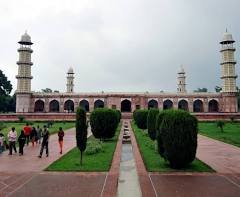
Nestled in the quiet locality of Shahdara Bagh, on the banks of the River Ravi in Lahore, lies one of the most magnificent yet often overlooked architectural gems of the Mughal era — the Tomb of Emperor Jahangir. Built in the early 17th century, this mausoleum is not only a resting place for the fourth Mughal emperor but also a timeless reflection of the empire’s love for art, symmetry, and nature.
Emperor Jahangir, who reigned from 1605 to 1627, was known for his refined taste in the arts, architecture, and governance. Unlike his father Akbar, Jahangir was not a conqueror by ambition but rather an aesthete — deeply invested in painting, garden design, and poetry. Upon his death in 1627, his son Shah Jahan, famed for later building the Taj Mahal, commissioned the construction of Jahangir’s tomb. The project took nearly a decade to complete and stands today as a lasting tribute to his father’s legacy.
The Tomb of Jahangir is one of the finest examples of Mughal architecture in Pakistan. Spread over 55 acres, the complex is a classic illustration of the charbagh (four-part) garden layout, symbolizing the Islamic concept of paradise. Unlike many other Mughal tombs, Jahangir’s tomb notably lacks a central dome, in accordance with his own wishes for simplicity. Instead, the structure is built in red sandstone with white marble inlays and is capped by four majestic minarets, each standing at 100 feet tall.
The interior is richly decorated with floral frescoes, marble panels, and intricate pietra dura — a technique involving the inlaying of semi-precious stones into marble. At the center lies the emperor’s marble cenotaph, inscribed with verses from the Holy Quran and the 99 names of Allah. The tomb, though understated compared to Shah Jahan’s later creation, is elegant and emotionally profound.
The tomb is more than a burial site — it is a symbol of the Mughal era’s cultural zenith in the subcontinent. It also reflects the architectural transition between the era of Akbar and the more ornate styles favored by Shah Jahan. Over the centuries, the tomb has witnessed the rise and fall of empires and was significantly damaged during the Sikh and British periods. However, restoration efforts have helped preserve much of its original beauty.
Today, the Tomb of Jahangir is a protected heritage site and a significant tourist attraction, drawing historians, photographers, and architecture enthusiasts from across the world. Yet, it remains less visited compared to other Mughal landmarks, giving it an air of serenity and mystery. Surrounded by gardens and flanked by nearby historical structures like the Tomb of Asif Khan and Akbari Sarai, it offers a full immersion into the architectural and spiritual soul of the Mughal dynasty.
The Tomb of Emperor Jahangir is not just a monument — it is a narrative carved in stone, whispering stories of love for art, a yearning for peace, and the legacy of an emperor who ruled not with conquest, but with culture. For those seeking to understand the depth of Mughal history in Pakistan, a visit to this tomb is both enlightening and unforgettable. It stands quietly in Shahdara Bagh, but its presence is anything but silent.
For tour arrangements in Pakistan, please feel free to contact us my telephone, WhatsApp or email us at Sakura Travel.
sakuratr2004@gmail.com
WhatsApp: 0092 332 8501039